

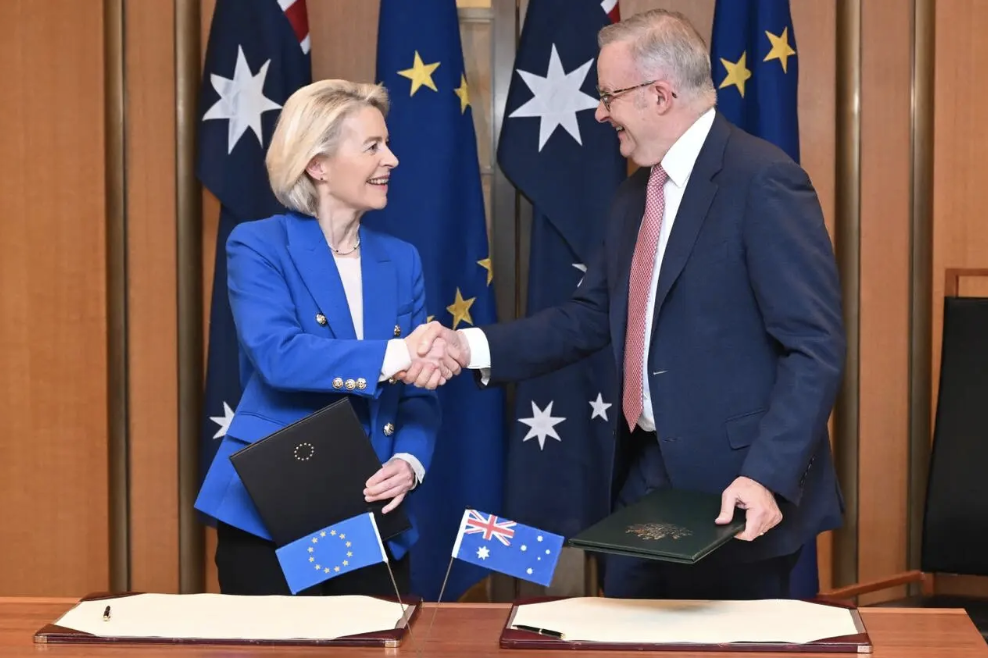
The European Union and Australia have reached a comprehensive trade agreement after eight years of negotiations, providing for a gradual reduction of tariffs. In the future, more than 90 percent of goods are expected to be traded freely between the two economies, while EU standards—particularly in climate protection—will continue to apply. The agreement is likely to significantly boost EU exports to Australia and substantially increase European investments there. At the same time, the EU is pursuing the strategic goal of reducing its dependence on China for key raw materials such as rare earths, cobalt, and lithium, for which Australia has extensive reserves.
The agreement comes amid growing geopolitical and economic tensions, including disrupted supply chains and uncertainties caused by international conflicts. European industries such as automotive manufacturing, mechanical engineering, and the chemical sector are set to benefit from reduced import tariffs in Australia, while agricultural products like beef may increasingly enter the European market. Unlike other trade agreements, such as those with South American countries, internal opposition within the EU remains limited, as the expected import volumes are relatively small.
Despite the economic opportunities, Australia remains a relatively minor trading partner for the EU overall. The agreement is therefore primarily seen as part of a broader strategy to diversify supply chains and strengthen resource security. In light of global competition and geopolitical risks, building strategic reserves and adopting a more economically focused energy and trade policy are becoming increasingly important for Europe.
Source: Zerohedge