

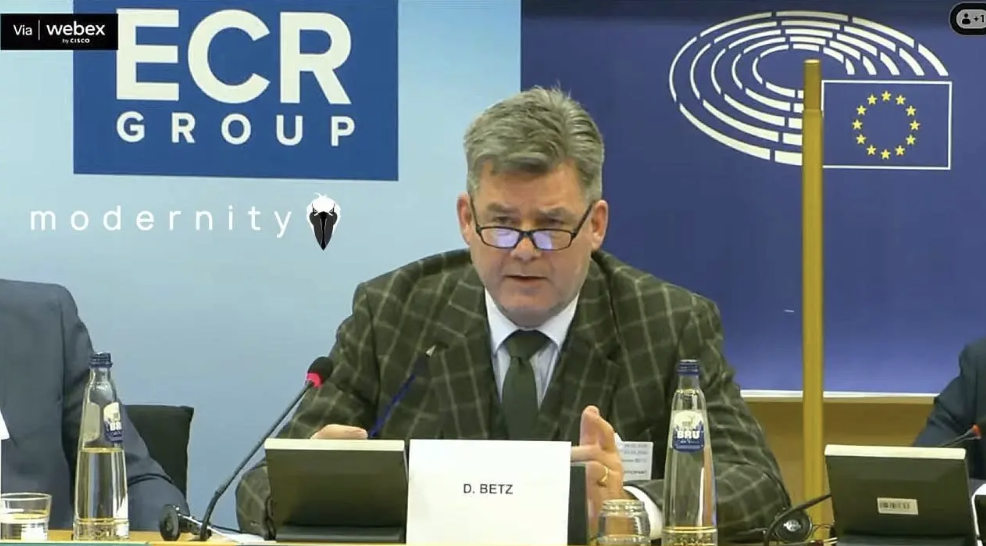
At a conference in the European Parliament, warnings were raised that Europe is heading toward civil war. The reasons cited included ongoing mass migration, declining trust between population groups, the emergence of so-called no-go areas, and growing social fragmentation along ethnic lines. Political scientist David Betz of King’s College London told lawmakers and experts that Europe is “on track for civil war.”
The event was titled “Civil War: Europe at Risk?” and was hosted by French politician Marion Maréchal and Swedish MEP Charlie Weimers (Sweden Democrats). A new report was also presented that aims to document up to a thousand no-go zones across Europe using publicly available data. Indicators considered included crime rates, sexual violence, youth gangs, unemployment, school performance, antisemitism, homophobia, mosque density, attacks on firefighters, and the presence of NGOs.
Maréchal said that formerly peaceful and stable societies were rapidly turning into environments marked by violence and mistrust. She described cultural homogeneity as the basis of trust and warned that it was eroding. She also spoke of already perceptible “diffuse guerrilla activity” in Europe, taking forms such as riots, looting, random attacks, “anti-white racism,” and terrorist attacks.
Weimers pointed to the effects of migration on social cohesion and said that Western democracies once relatively homogeneous had become deeply fragmented. Newcomers often shared little with the indigenous population, and in some cases there was no intention to assimilate. Both hosts said the conference was driven by the aim of finding political solutions and preventing a civil war.
Betz outlined a possible scenario of a conservative revolt against elites who, in his view, had violated obligations under the “social contract” and changed the rules against the population’s wishes. He compared a potential trajectory to Italy’s Years of Lead, the “dirty wars” of Latin America, or Northern Ireland’s Troubles, but on a larger scale. He also predicted that already guarded societies could become more heavily fortified systems with more walls, guards, and surveillance, and he spoke of an advancing “Balkanisation” of British life along ethnic lines.
As examples, Betz cited areas such as Tower Hamlets in London and Sparkhill in Birmingham, describing them as ethnic enclaves with “negotiated policing,” parallel legal systems, alternative economies, and forms of large-scale sexual violence against out-groups. He added that there were people in government who understood the gravity of the situation but did not speak openly about it for career reasons.
Weimers asked where Europe would be in 50 years and whether Europe would still exist by then. Betz said any future escalation could take the form of the siege of cities with 21st-century twists and could resemble Sarajevo, while being more heavily dominated by paramilitary actors using system-disruption tactics. He cited infrastructure attacks as a key method to weaken the life-support systems of urban, non-native enclaves and described the political objective as compelling “non-natives” to leave by making city life so intolerable that leaving would be preferable to staying.
Betz emphasized the vulnerability of fuel systems, saying they were easy to attack, flammable or explosive, difficult to repair, and expensive to replace, and that replacement would be nearly impossible under civil war conditions due to the lack of insurance. Fuel disruptions would quickly trigger knock-on effects across logistics, especially food distribution, which he described as a traditional weapon of siegecraft. The report also referenced warnings by retired British Army Colonel Richard Kemp, who said integration breakdowns had worsened over the past two decades and that no UK government had the courage to stop developments he linked to an “Islamification” of Britain.
Source: ZeroHedge